Documentary evidence of sending and receiving
Electronic notification
Pay per use. No registration fees. No expiration date.
As simple as sending an email.
Sign documents and contracts
Our locations We are global
Lleida
Madrid
Paris
London
Miami
Dubai
San José
Bogotá
São Paulo
Tokyo
Santo Domingo
Cape Town
Johannesburg
Montevideo
Santiago de Chile
Lima
Beirut
Ciudad de México

Our customers trust us
Case studies
We particularly loved the ease and agility of contracting the system and its credit-based use. In other words, you top up some credits and start working without too much training, without any specific software installation or technical complexity
Registered notification service has made possible to help in the internal operating processes of companies and in their digital transformation.
Lleida.net gives us peace of mind and guarantees that parents verify the engagement of our services in a simple safely and legally way.
Connectaclik Pro has provided Holaluz with effective and customized solutions,a must have for any services we will add to our processes.
“Thanks to this agreement we would provide security, reliability and efficiency to our users. Being a technological platform it is crucial to offer the highest quality and the greatest attention to our customers”


News, interviews, tutorials
Blog

 29 July, 2026
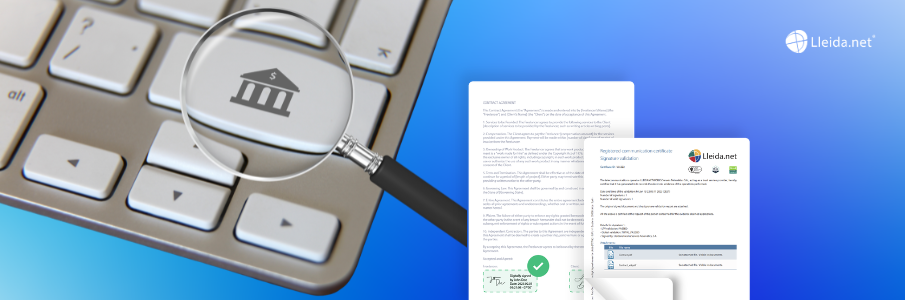
eSignature Validator: The Proven Way to Stop Document Fraud
Law firms increasingly face a high-stakes scenario where a reliable esignature validator makes all the difference: a client receives a digitally signed contract or notice binding their company to a multi-million-euro transaction. The document appears entirely authentic, complete with a digital signature and a secure timestamp, yet subtle timeline discrepancies or irregularities raise red flags.
Faced with this challenge, utilising a reliable esignature validator is essential before taking action, as challenging a signature without solid technical backing can result in severe financial exposure. Under procedural rules inspired by EU civil litigation standards and the eIDAS framework, if a document is proven valid, the challenging party typically bears the legal costs and potential financial penalties for procedural bad faith.
Counsel is inevitably left asking how to verify whether a signed document is genuine or forged with sufficient certainty to litigate or advise with confidence.
The Universal eSigned Verifier from Lleida.net, known as USVC, acts as the ultimate esignature validator for legal practices. It enables legal teams to complete verification in minutes, completely removing the need for prior technical setup.
Document Fraud Makes an eSignature Validator Essential
Global regulatory bodies and legal authorities report a continuous rise in document fraud. Traditional manual forgeries of paper records have been largely replaced by sophisticated digital alterations of contracts, corporate certificates, identification documents, and electronic receipts, fuelled by advanced editing software and artificial intelligence.
This evolving threat has pushed forward-thinking law firms to adopt an automated esignature validator, embedding document authentication directly into their intake and review workflows to neutralise risks before a dispute ever reaches court.
USVC: The Forensic Methodology Behind This eSignature Validator
The process is frictionless: legal teams simply email the file or run the check through the secure online portal. Within minutes, the platform returns a full verification result, along with documentary evidence of full probative value, to send to auditors, regulators, or judicial bodies.
USVC Ensures Complete Integrity, Authenticity, and Legal Validity
As an advanced esignature validator, the Universal Signed Document Verifier overcomes several technical hurdles that traditional checks cannot:
- Confirms absolute document integrity by validating the underlying cryptographic hash and detecting any unauthorised alteration, regardless of visual seals.
- Determines whether the uploaded file is the pristine original signed document or a degraded secondary reproduction.
- Evaluates certificate validity as of the exact moment of signing, even if the certificate has since expired, by leveraging advanced LTV/LTA mechanisms compliant with European eIDAS standards (Regulation (EU) No 910/2014).
- Validates whether the signature carries an official timestamp and confirms strict temporal consistency.
- Audits the issuing digital certificate against recognised Trusted Service Lists across the EU (EU TSL) or approved international certification authorities and repositories.
- Operates entirely zero-touch, with no complex API integration or IT setup required.
- Generates a litigation-ready report that can be filed directly in court proceedings as objective expert evidence.
Real Cases: Verifying Electronic Signatures in Legal Practice
For practising attorneys, using USVC as a trusted esignature validator transforms decision-making, whether evaluating a settlement, drafting a motion, or advising corporate clients, shifting the process from subjective visual judgment to an objective, data-driven strategy.
Below are three case studies from firms that use USVC in their workflows.
Case 1: Verifying the Cryptographic Signature, Not the Visual Seal
A commercial law firm handles a multipage lease agreement signed electronically, where the visible signature block appears only on the final page. The opposing party moves to challenge the contract, arguing it is legally incomplete because it lacks a signature on every page.
Counsel runs the file through USVC as an esignature validator to verify the cryptographic hash. The report confirms the file is unaltered, and the signature is legally binding under digital signature frameworks. The court dismisses the challenge and orders the opposing party to cover the verification costs.
The Takeaway: Visual signature stamps are cosmetic placeholders. True electronic validity depends on cryptographic integrity across the entire file hash, not on how many pages display a graphic signature.
Case 2: Copying, Reprinting, or Rescanning Destroys Digital Evidence
A corporate client hands their attorney a printed copy of a contract that was originally executed digitally. The printout looks visually identical to the original agreement, but when a dispute arises, running a flat scan through an esignature validator fails: a scanned or reprinted copy strips out the embedded digital certificate and cryptographic payload, reducing the document to ordinary documentary evidence and weakening the client's position.
Lawyers should always request the native digital file from clients rather than a printout or scan. If only a reproduction is available, running it through the esignature validator early reveals its limitations immediately, allowing counsel to adjust their evidentiary strategy before filing.
The Takeaway: Always secure the native digital file to preserve embedded metadata; a reproduction loses its legal force.
Case 3: Unfounded Challenges Carry Financial Consequences
A firm initiates a debt recovery action supported by an electronically signed loan agreement. The debtor challenges the signature purely as a delaying tactic to force a settlement discount. Plaintiff's counsel relies on the esignature validator before responding, confirming the file's integrity.
Backed by solid technical proof, the lawyer stands firm and files the verification report directly in opposition. The judge dismisses the challenge, orders the debtor to cover all verification costs, and penalises them for procedural bad faith.
The Takeaway: Objective technical validation through a reliable esignature validator lets legal counsel confront unfounded procedural challenges with confidence, shifting the financial penalty onto the bad-faith party.
USVC gives legal professionals the technical backing they need to act as confident, informed users of an esignature validator, protecting clients from costly procedural missteps and aggressive opposing tactics.
YOU MIGHT ALSO LIKE:
Legal validity of PDF signatures: how to secure it with qualified time stamping
 29 July, 2026
New Consumer Credit Contract Law: What It Requires and How to Prepare
Consumer credit has stopped being reserved for big-ticket purchases. Today, people finance everyday spending too, from essential goods to everyday services, and that shift has turned credit into a routine payment method for a large share of the population.
This growth is forcing both traditional lenders and financing platforms to rework their processes at the speed the fintech ecosystem now demands.
In Spain, that shift is being met with a new consumer credit contract law: the draft bill on consumer credit agreements published earlier this year. It's not final yet; it still has to clear several legislative stages before entering into force, but it already outlines the roadmap for how consumer lending will need to be managed and documented going forward.
Although this consumer credit contract law is Spanish legislation, it transposes an EU-wide directive, so the direction of travel matters well beyond Spain's borders: any lender, fintech, or financing platform operating across the EU/EEA, or planning to enter the Spanish market, will be dealing with an equivalent framework in due time. This article breaks down what the draft law will require, and how you can start reviewing your digital processes before it's formally approved.
What Will the New Consumer Credit Contract Law Cover?
This new consumer credit contract law, the EU's Consumer Credit Directive, will be incorporated into Spanish law and will require digital processes to be more transparent, verifiable, and traceable, building a reinforced consumer-protection framework across the entire contracting journey.
Specifically, the draft law introduces obligations to: prove delivery of pre-contractual information; document the information given to the consumer; formalise contracts on a durable medium; evidence withdrawal; send reminders; and maintain traceable complaint-handling procedures. It also regulates phone-based contracting, automated offers, and creditworthiness assessments.
The rule will apply to all forms of consumer financing, from standard consumer credit to microcredit and fast loans issued through digital platforms.
The new consumer credit contract law will replace and expand the current regulatory framework for consumer credit. Specifically, it will:
- Repeal the current Consumer Credit Contracts Act (Law 16/2011)
- Repeal the Distance Marketing of Financial Services Act (Law 22/2007)
- Amend the recast General Law for the Protection of Consumers and Users
- Amend Law 10/2010 on the prevention of money laundering and terrorist financing
The consumer credit contract law also anticipates a follow-up implementing regulation (a royal decree) for certain matters, to be developed further through ministerial orders.
The Consumer Credit Contract Law in Detail
From Sending Information to Proving It Was Delivered
Under Article 26 of the Consumer Credit Contract Law, lenders must provide the European Standardised Information Sheet (ESIS) to the consumer clearly and comprehensibly before the consumer becomes bound by the credit agreement. For certain transactions, this information must be delivered at least 24 hours in advance.
When the documentation is provided with less notice, the lender must later send a reminder about the consumer's right to withdraw and the procedure for exercising it.
Registered electronic communications, whether Registered email or Registered SMS, can provide legally valid traceability for the delivery of pre-contractual documentation and any follow-up reminders.
Consumer Explanations Must Also Be Documented
Under Article 27.3 of the consumer credit contract law, lenders and intermediaries must give the consumer individualised explanations about the product and be able to prove when and how those explanations were provided.
Lenders will need to think through how they record:
- What explanation was given
- What documentation was shown
- What channel was used
- The exact date and time
- What action did the consumer take
If the agreement is arranged by phone, the consumer must be given a description of the service's main features before the call ends, and the ESIS must be provided on a durable medium immediately afterwards.
The lender must also keep the recording containing the pre-contractual explanations.
Why the Durable Medium Requirement Matters
Under Article 34, contracts and any amendments must be formalised in writing or on another durable medium, and all parties are entitled to receive a copy.
The contract must also specify the medium the consumer has chosen for receiving reminders, amendments, and other communications once the agreement is in place. Whether the lender sends a binding offer or a personalised one, the consumer must always be clearly informed, and that must be documented.
"Durable medium" shouldn't be read as simply emailing a PDF of the contract. It must let the consumer store the information, retrieve it for an adequate period, and reproduce it unchanged.
The Right of Withdrawal Moves Into the Digital Interface Itself
Under Article 47 of the Consumer Credit Contract Law, consumers have 14 days to withdraw from the agreement. Lenders must manage both the receipt of the withdrawal notice and the traceability of exactly when the right was exercised, along with its content.
Websites and apps used for contracting will also need a visible, permanently accessible withdrawal function, and lenders must confirm receipt of the withdrawal request to the consumer.
Document Retention for at Least Six Years
Under the third additional provision, lenders must retain pre-contractual information documents for a minimum of 6 years after the contract's termination, and must make them available to the consumer upon written request.
Complaint Registration and Traceability
Under Article 51, lenders must maintain an effective, transparent, and free complaints service and log every complaint received, along with the steps taken to resolve it. A registered communication channel enables the legal evidence of both the receipt of the complaint and the acknowledgement sent to the consumer.
Notice Requirements Before Early Termination
Under Article 60, before declaring early termination of the contract, the lender must send the consumer a notice at least one month in advance, stating that they have that period, from receipt, to bring payments up to date.
Is Your Organisation Ready for the Change?
With the consumer credit contract law on the horizon, the real question for any organisation operating in the consumer credit market today isn't "can we communicate, inform, or contract with consumers?", it's "can we prove that pre-contractual information was delivered? Do we log the explanations given to each customer? Can we evidence subsequent amendments and notifications?"
Building a structure to prove compliance will be one of the foundations of trust in digital credit management going forward. Organisations that treat this not just as a legal project, but as a technological, documentary, and operational shift, will gain a structural advantage over their competitors.

You might also like:
Why companies are adopting video ID and digital authentication as standard
E-signatures via WhatsApp: Why accessibility matters more than complex tech.
 22 June, 2026
How to Prove Prior Consent in Energy Sales in Spain (RD 88/2026)
On 12 June, a critical change affected energy sales in Spain operations under the General Regulation on Electricity Supply (RD 88/2026). The articles regulating how consumer consent must be requested, captured, and verified before any telephone sales contract are now legally enforceable.
For international companies managing clients, expats, or corporate entities residing in Spain, adapting to new energy sales in Spain frameworks marks a major operational shift. The ultimate goal of the regulation is to put a definitive stop to unsolicited and abusive outbound marketing calls within the Spanish territory.
In this new regulatory landscape, non-compliance is no longer just a matter of customer annoyance; it is a severe legal risk. If a commercial call is made without meeting the strict criteria for energy sales in Spain, or if the consumer is misinformed about tariffs or terms, the resulting contract can be declared null and void under Spanish law.
This creates a brand-new operational environment, further reinforced by Spain’s well-known Customer Service Act (Ley SAC). Together, these regulations aim to protect consumers and eradicate aggressive sales tactics. As a result, companies involved in energy sales in Spain channels, regardless of where their headquarters are based, must fundamentally rethink how they engage with local prospects to build sustainable, trust-based relationships.
This is precisely where Lleida.net trust services come into play. Every single step of the process, every communication, every agreement, and every sign-off now needs to be recorded, securely stored, and irrefutably certified as if prepared for a court of law. The era of mere data accumulation is over; we are now firmly in the era of digital evidence.
What the Regulation Demands: Proving prior consent in energy sales in Spain
RD 88/2026 is built upon a premise that completely flips traditional outbound marketing strategies on their head: companies managing energy sales in Spain no longer choose whom to call; consumers in Spain choose whether they want to be called. The regulation strictly prohibits unsolicited telephone marketing and contracting directed at individuals within the country, allowing only two strict exceptions:
- A prior, express, unambiguous, and informed request from the user for a specific, defined purpose.
- When the consumer initiates the call themselves.
Gathering express consent has evolved from an industry best practice to a strict legal obligation, with rigorous validity requirements for energy sales in Spain. Consent must stem from a direct, conscious action by the user, free from intermediaries or external incentives unrelated to the energy supply itself. Furthermore, once the call is underway, it must be recorded in its entirety, the consumer must be clearly informed of how and where to file complaints, and they must explicitly authorise the recording from start to finish.
The Legal Evidence Required for Energy Sales in Spain Compliance
Requesting consent correctly is only half the battle; the other half is proving it. Crucially, under Spanish law, the burden of proof rests entirely on the company driving the energy sales campaign in Spain, never on the consumer.
The Regulation is highly specific about the documentation required for energy sales compliance in Spain, which must be retained in a durable medium when dealing with individual consumers. According to Article 13.ah).1.º of RD 88/2026, the digital trail required to prove valid consent includes:
- User Identification Data: Unless the user signs the contract using a qualified digital certificate or confirms the transaction via electronic means certified by a trusted third party.
- Proof of Pre-Contractual Disclosure: Irrefutable evidence of the exact time the offer summary document was sent to the consumer or, if not delivered in writing, the exact moment it was read by them.
- The Completed and Signed Contract: Executed by the consumer.
- The Full Call Recording: When contracting takes place over the phone, the complete audio recording must be securely stored and made readily available to the consumer upon request.
From a legal perspective, the shift is absolute. It is no longer enough to simply inform the consumer. The regulations demand a robust, traceable, and verifiable chain of custody, a complete audit trail that proves every interaction and validates consent before any sales contact takes place.
How Lleida.net Solves It: One Process, One Single Provider for International Operations
As an EU-Qualified Trust Service Provider, Lleida.net has spent years certifying the exact processes that RD 88/2026 now mandates. We help international companies manage secure energy sales in Spain, onboarding and contracting workflows that protect the business without disrupting the user experience, ensuring compliance teams don't have to manually piece together evidence files across borders every time a local dispute arises.
Here is how our fully deployed, step-by-step workflow operates in practice:
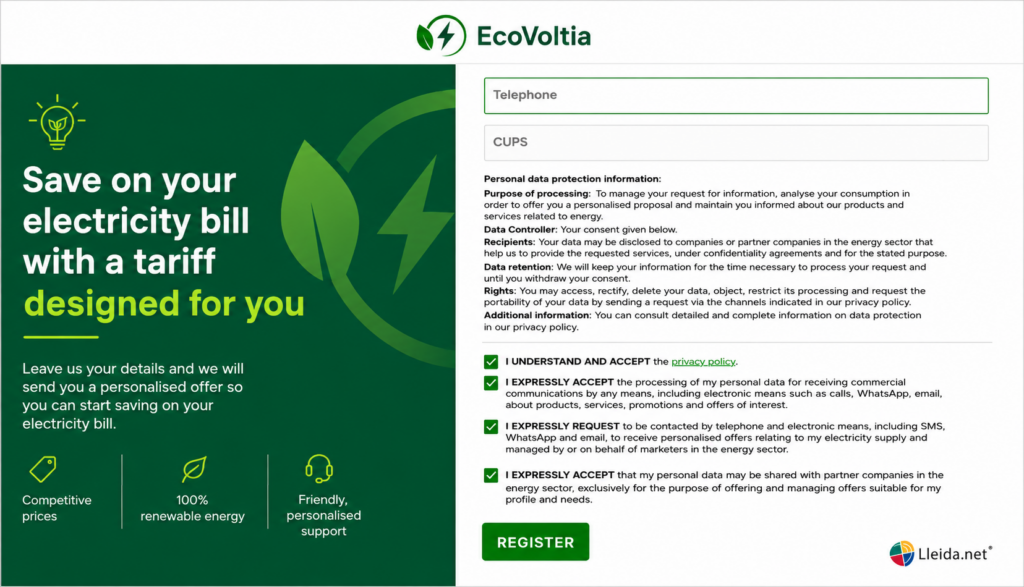
- Inbound Intent: The consumer fills out a form on the provider's landing page, entering their details and phone number to request a callback, granting explicit consent. This transaction is immediately timestamped and certified as immutable from the very first click. This proves, from the source, that the consumer initiated the interaction.
- Instant Registered Delivery: The offer summary document is dispatched either during or immediately after the call via Registered SMS or Registered Email. This generates irrefutable proof of sending, delivery, and, if the customer clicks the link, the exact moment it was read. This single, automated step fulfils the Spanish disclosure requirement without relying on sales agents to manually log data into a CRM.
- Seamless Digital Execution: Both consent confirmation and contract execution are captured via Click & Sign, our advanced electronic signature solution. All metadata and digital evidence (date, time, IP address, device details, and signer actions) are linked to a single, tamper-proof certificate. The customer approves everything directly from the SMS or email link they received, no downloads or external portals required.
- Enhanced Security: When a more robust identity verification is required, especially for international users, corporate signers, or expats living in Spain, the onboarding process seamlessly integrates with eKYC Video, our secure video-identification tool.
Every stage of this workflow is anchored by a Qualified Electronic Timestamp. The date and time of each piece of evidence do not rely on internal company servers, but are verified by an EU-qualified trust entity under the strict guidelines of the eIDAS Regulation, making it fully valid across Europe and within Spain.
The final output is not a scattered collection of files spread across different vendors, but a comprehensive, legally binding audit trail securely stored in a single, durable medium. In a single streamlined flow, you have airtight proof that the consumer requested contact, received the required pre-contractual information, verified their identity, and signed the contract.
Why Waiting is a Risk for Your Energy Sales in Spain Strategy
Moving forward, any commercial call placed to prospects regarding energy sales in Spain without an ironclad, verifiable consent process will be deemed an irregular practice, exposing your organisation to severe financial penalties and reputational damage under local regulations. Do not jeopardise your commercial strategy by delaying necessary operational updates for your compliance systems.
If you want to evaluate how to integrate Spanish compliance seamlessly into your existing telephone onboarding channels, let's talk.